Building Retaining Walls That Last: Overcoming Saturated Clay Soil and Winter Freeze-Thaw
Drive around any older neighborhood in Southwest Ohio and you will see them: retaining walls bulging outward, leaning downhill, blocks separating at the joints. Almost none of those walls failed because the block was bad. They failed because of water and base, the two things our clay soil punishes hardest. A retaining wall that lasts here is designed for our specific conditions, and the parts that matter most are the ones you never see.
The real enemy is water, not weight
People assume a retaining wall fails because the soil is too heavy for it. In reality, the culprit is almost always hydrostatic pressure, water building up in the soil behind the wall with nowhere to escape. Our regional clay holds enormous amounts of water and drains painfully slowly. When that saturated soil sits against a wall and then freezes in winter, it expands and shoves the wall outward with tremendous force. Do this every freeze-thaw cycle for a few winters and even a well-stacked wall walks out of alignment.
Drainage: the part you pay for and never see
A wall built to last in Ohio includes a complete drainage system behind it. This is what separates our retaining wall construction from a quick stack of block.
- Gravel backfill. A zone of clean, angular stone directly behind the wall gives water a path down instead of letting saturated clay press against the block.
- Drainage pipe. A perforated pipe at the base collects the water that reaches the bottom of the gravel.
- Outlets that daylight. That pipe has to actually go somewhere, discharging the water away from the wall and the foundation.
- Filter fabric. Fabric keeps clay fines from migrating into the gravel and clogging the drainage over time.
On many properties, the wall's drainage ties into the broader lot drainage. When a wall sits where water naturally collects, we integrate it with french drain and downspout solutions so the whole system moves water away rather than trapping it behind the block.
The base determines everything above it
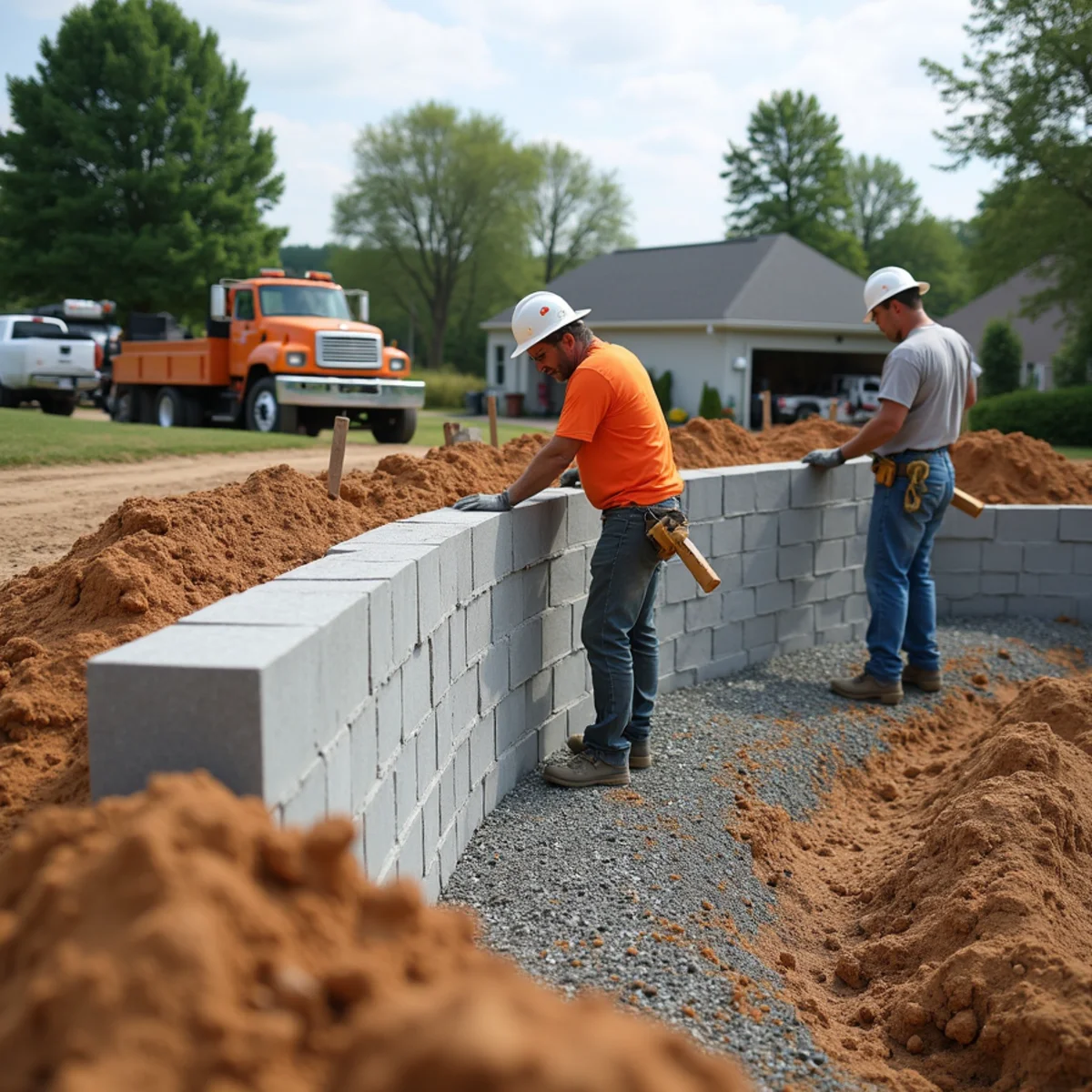
A retaining wall is only as stable as what it sits on. In our frost-prone clay, that means excavating below the disturbed soil, building a compacted aggregate base of the right depth, and leveling it precisely. The first course of block has to be dead level and set correctly, because every error there multiplies up the wall. A base that is too thin, or built on soft clay that was not compacted, lets the whole wall settle and tip.
Batter, reinforcement, and height
Well-built walls lean back slightly into the hill, a deliberate angle called batter, so the wall's own geometry resists the soil's push. As walls get taller, the loads grow quickly, and at a certain height we add geogrid, layers of reinforcing fabric that extend back into the soil and tie the whole hillside and wall together into one mass.
- Short garden walls rely on base, batter, and drainage.
- Taller structural walls add geogrid reinforcement and often stepped or deeper bases.
- Walls above a few feet or holding significant load may require engineering and permits.
Local soils, local knowledge
Soil conditions vary even within our service area. The dense glacial till common around Hamilton behaves differently than the soils out near Oxford, and a wall design that works on one site may need adjusting on another. Building here for years has taught us to read the soil in front of us rather than apply a generic spec, which is exactly why locally built walls outlast walls put up by crews passing through.
Caps, geotextiles, and the finishing details
The details at the top and bottom of a wall matter as much as the block in between. A properly installed cap sheds water off the top of the wall instead of letting it run down into the cores and backfill, and it gives the wall a clean, finished edge. A geotextile separation layer between the native clay and the base keeps the two from mixing and pumping under load. And the grading above the wall should carry surface water away from the top rather than funneling it in behind the block. These are the touches that separate a wall that merely stands from one that stays crisp and dry for decades, and they cost very little to do correctly at the time of construction.
The step bargain crews skip on every wall
If we had to name the one step that separates a wall that lasts from one that leans, it is compacting the base and the backfill in lifts. A bargain crew dumps gravel, sets block, and backfills all at once. The stone then settles unevenly over the first year, the first course goes out of level, and that error climbs the whole wall. Compacting in shallow layers is slow, unglamorous, and exactly why it is the first thing skipped.
The second shortcut is backfilling with the native clay that was just excavated instead of clean angular stone. Clay against the block traps the very water the wall needs to shed. Where a wall meets a patio or steps, we tie the drainage and base together with our paver patio and walkway work so the whole assembly drains as one, rather than trapping water at the seams.
The hidden layers of a wall built to last
- A compacted aggregate base set below the disturbed soil.
- Clean angular gravel backfill directly behind the block.
- A perforated drain pipe that daylights to a real outlet.
- Filter fabric separating clay from the gravel, and geogrid where height demands.
Do it right once
A retaining wall is a serious investment, and rebuilding a failed one costs far more than building it correctly the first time, because you pay to demolish and haul the old wall before you even start. The money that makes a wall last goes into drainage, base, and reinforcement, the parts a bargain bid leaves out. If you are planning a new wall or watching an old one lean, call Galan's Landscaping at (323) 606-0255 and we will design one built for Ohio clay and freeze-thaw, so you build it once.
Frequently Asked Questions
Almost always because of trapped water. Saturated clay behind a wall builds hydrostatic pressure and, when it freezes and expands, pushes the wall out of alignment. Walls without proper drainage fail within a few freeze-thaw winters.